






In celebration of 30 years since the premiere of its inaugural work, Marrugeku returned to Gunbalanya – the community in West Arnhem Land where the company began with its first-ever production, Mimi.
To mark the occasion and remember the Kunwinjku Elders who guided the work, a special screening of Mimi was presented in a Community Event in conjunction with the Stone Country Festival, Gunbalanya.
Now Australia's leading intercultural and trans-Indigenous dance theatre company, Marrugeku is globally recognised for work of extraordinary quality incorporating theatre, multimedia installations and diverse styles of dance.
Marrugeku continues to bridge remote and urban dance and performance communities, connecting Indigenous and non-Indigenous artists and audiences, while responding to local and global contexts. Through its hallmark intercultural process driven work and startling interdisciplinary practice, the company creates performances grounded in collaboration between Peoples, Country and custodians to speak to diverse Indigenous and settler audiences across Australia and around the world.
With its first tour of Mimi in 1996 to neighbouring communities across Arnhem Land and its second tour in 1997 to Europe, the company captured national and international attention. The need to communicate in different ways to diverse audiences defined the company's practices and production values, and has seen them tour works from Australia around the world – including in The Netherlands, France, Belgium, Germany, Spain, Luxembourg, the UK, Ireland, The Phillipines, New Caledonia, Aotearoa /New Zealand, Vanuatu, Fiji, the USA, Canada and Brazil.
Marrugeku continues to play a vital role in raising global awareness of the diversity of Indigenous experience, powerfully confronting the complex social realities of contemporary Indigenous life while meeting the urgent need for truth telling about Australia's past and Makarrata.
Founded in 1994 to create Mimi, Marrugeku began with a radical and ambitious collaboration based on an idea by Gamilaroi and Mandandanji choreographer Michael Leslie and directed by co-artistic director of Stalker Theatre Rachael Swain. Commissioned for the 1996 Festival of Perth, Mimi was developed in Gunbalanya in partnership with Kunwinjku storytellers, musicians and dancers, West Australian Indigenous performers, and physical theatre artists from Stalker Theatre.
"After discussions with Michael Leslie and Rachael Swain, the Festival commissioned the new company to develop its first work, Mimi, for ground-breaking performances at the 1996 Festival," said Henry Boston, former general manager, Festival of Perth.
"It was the first time that the stories of the Kunwinjku people of Western Arnhem Land had been presented in Perth and the audiences loved the show.
"Since then, Marrugeku has gone from strength to strength, under the leadership of Rachael and Dalisa Pigram, to become a very special intercultural company and a great ambassador for Australia across the globe. I couldn't be prouder of this legacy."
Mimi was widely acclaimed and created a sensation in Australia and worldwide.
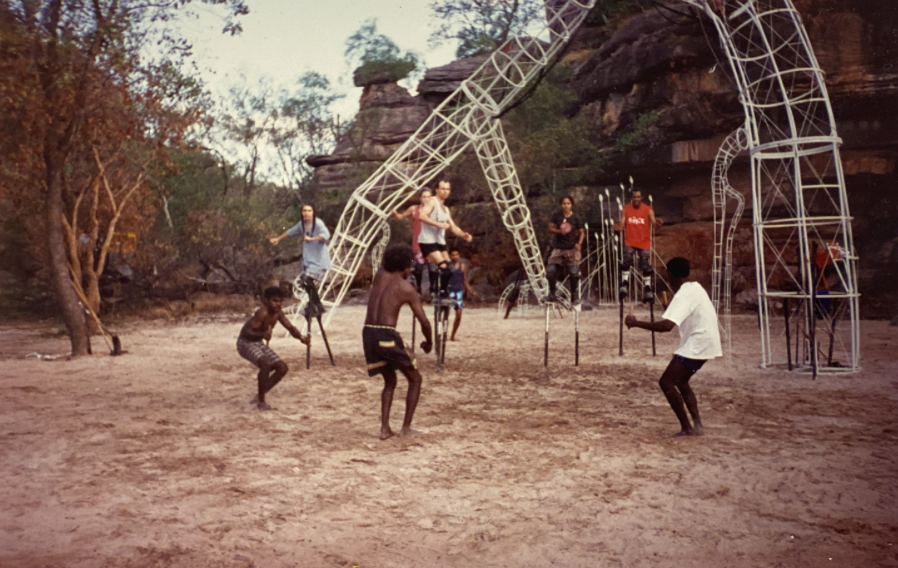
Inspired by the stories of Kunwinjku painter Thompson Yulidjirri and the Karrparra song cycle of songman Bruce Nabegeyo, Mimi explored the connection between humans and the spirit world. Featuring stilt dancers, traditional performers, live musicians, and narration by Yulidjirri, the work was widely acclaimed for its skill, beauty and innovation. Touring nationally and internationally, Mimi was notably presented at the Olympic Arts Festival in Sydney, represented Australia at World Expo 2000 in Hannover, and welcomed the new millennium live from Uluru on ABC TV.
Since those beginnings, culturally located in Gunbalanya and produced from Sydney, Marrugeku has evolved into a major force in intercultural and Indigenous performance. In 2003 the company began a new project in Broome, WA – home to several founding members – and in 2008 appointed Broome-based dancer Dalisa Pigram as co-artistic director alongside Sydney based director Rachael Swain.
In 2025, with bicoastal operations in NSW and WA and enjoying remote, regional, national and international reach with its groundbreaking productions, Marrugeku also celebrates 21 years of its cultural home base in Yawuru Country, Broome, WA.
Together, Swain and Pigram guide Marrugeku's artistic direction in collaboration with community and cultural leaders. Swain is a director, dramaturg and performance researcher who supports the company's development of innovative intercultural practices and interdisciplinary collaboration. Pigram, a dancer, choreographer, and Yawuru language teacher brings a strong commitment to contemporary Indigenous performance rooted in community and cultural knowledge. The duo works closely with Yawuru cultural leader and Marrugeku Patron and principal cultural dramaturg, former Senator Patrick Dodson, ensuring the work is grounded in cultural integrity and meaningful collaboration.
After many years of connection and return visits, Dalisa, Rachael and a small group of original artists from Mimi and the following work Crying Baby were invited to join the Gunbalanya community in celebrating Marrugeku's beginnings in advance of the Stone Country Festival, hosted by Injalak Arts.
The event enabled the first community screening in Gunbalanya of the full-length video of Mimi – filmed at the Festival of the Dreaming, Centennial Park, Sydney, 1997 where it was presented to over 13,000 people.
Dalisa Pigram and Rachael Swain jointly commented: "The Stone Country of West Arnhem Land is such a special place to all of us who were there in the beginnings of Marrugeku's story. It holds the people and stories that brought us together and we hold tightly to the strong memories that have shaped our directions since making Mimi and Crying Baby together. The essence of what was learned and shared between such a diverse group of artists under the watchful eye of the Kunwinjku custodians continues to pulse in our work today. We will forever be grateful to have been part of the journey that began in the white riverbeds and under the escarpments of the Kunwinjku custodians."
For more fashion, arts, culture and lifestyle news subscribe for free to the Style Up newsletter.
As Marrugeku marks 30 years since its inaugural production Mimi, more events will be announced.