





A new interactive 3D virtual tour is giving viewers around the world unprecedented access to one of Rapa Nui's (Easter Island) most significant cultural sites without setting foot on the island.
The online experience presents a high-resolution three-dimensional map of the moai statue quarry at Rano Raraku, located on Rapa Nui.
Developed using advanced spatial and imaging technology, the project allows users to explore the volcanic crater where the majority of the island's moai were carved, many of which remain partially embedded in the rock face.
The virtual model documents nearly 1,000 statues and surrounding landscape features which are difficult or impossible to view during a physical visit due to safety restrictions and conservation controls.
The project is well-timed during conversations about cultural preservation, environmental pressure and the impact of tourism on the remote Pacific island, which is home to around 6,000 residents.
For many Rapa Nui people, digital documentation is not simply about access but protecting cultural identity for future generations.
%20Quarry%20at%20Rano%20Raraku%20Rapa%20Nui%20(Easter%20Island%20Chile).png)
CyArk, a global non-for-profit organisation which uses advanced digital technology to record and preserve cultural heritage sites, is working with local communities to safeguard them for future generations. It previously published its own virtual tour of Rapa Nui.
A contributor to the CyArk digital preservation project and local, Henriet Paoa Hucke, spoke to the deep personal connection between Rapa Nui people and their ancestral landscape.
"To know your identity, you wake up where it is supposed to be your home. And our home is the island," Ms Paoa Hucke said.
"...The Moai and everything that has been around the island is more than our heritage, it is each one of us.
"Every stone of a pipi horeko is each one of us. Each of them live in us. It would be sad to lose more things than we have already lost."
Local student Merahi Edmunds emphasised the role of digital preservation in maintaining cultural continuity.
"They are important because apart from being a physical record our culture, it is a way of remembering our culture..." Ms Edmunds said.
"It is part of who we are."
For Rapa Nui families, access to these digital records carries long-term significance beyond academic research.
Daniela Marchant, another CyArk contributor, framed the technology as a bridge between generations.
"I am interested in this being maintained so that my son in the future can have access to know these sites that represent his culture," Ms Marchant said.
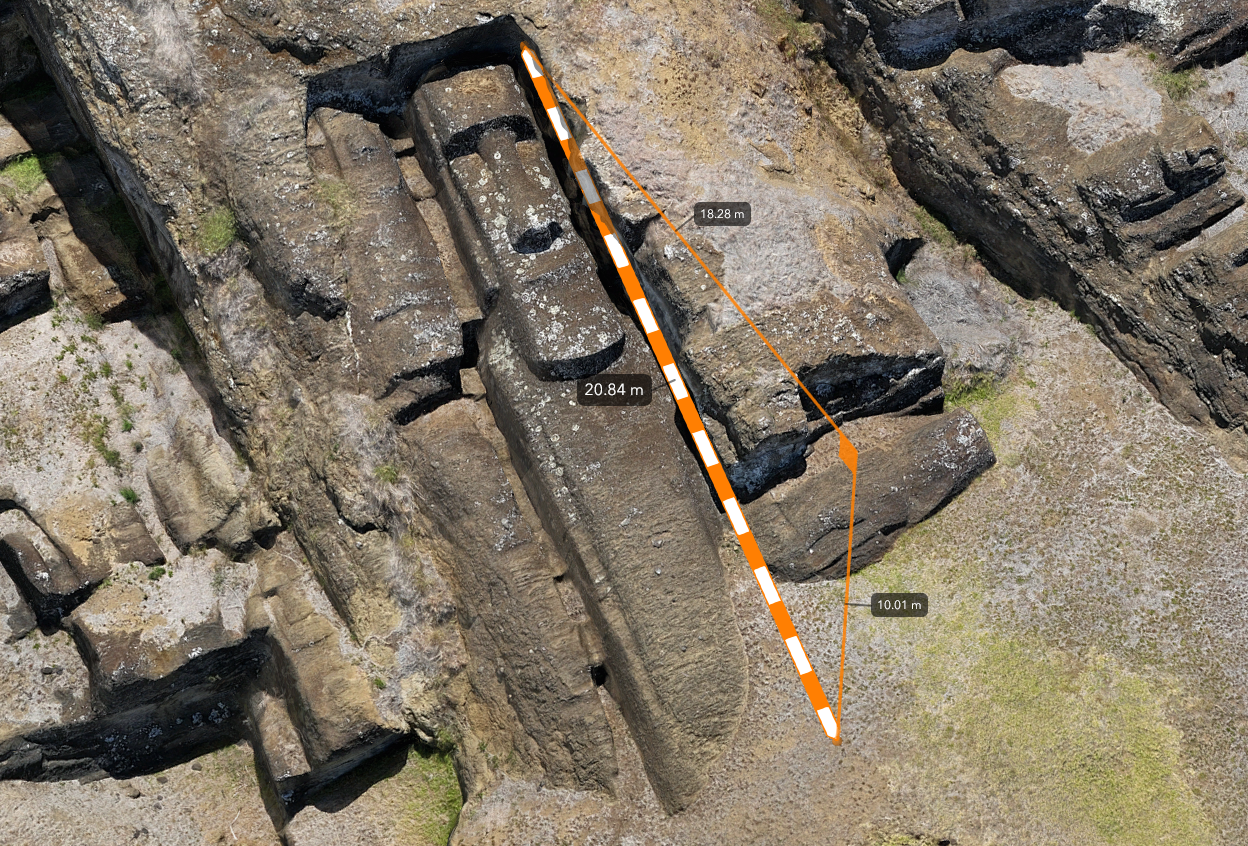
The 3D mapping of Rano Raraku was produced by a team of researchers and geographers, including academics from Binghamton University and the State University of New York.
One of the project's key researchers is anthropologist Carl Lipo, who has spent years studying the moai and the quarry landscape.
Mr Lipo said the model reveals perspectives which are not possible to observe on the ground.
"You can see things that you couldn't actually see on the ground," he said.
"You can see tops and sides and all kinds of areas that [you] just would never be able to walk to."
He added the digital approach allows researchers to document the site in a way that is both comprehensive and widely accessible.
"We're documenting something that really has needed to be documented, but in a way that's really comprehensive and shareable," Mr Lipo said.
The research team recently published academic findings linked to the model in PLOS One.
While the model supports research, its creators also see public education as a central outcome.
Mr Lipo has described the quarry as an immersive space that benefits from virtual exploration.
"The quarry is like the archaeological Disneyland," he said.
Mr Lipo recently sat down with YouTuber Stefan Milo who has a B.A in Archaeology and Anthropolgy to showcase and discuss the project in further detail.
For Rapa Nui, projects such as this offer a way to balance global interest with local responsibility, allowing people to learn from a distance while reducing pressure on fragile cultural sites.
As digital technology continues to evolve, community-centred preservation projects are increasingly seen as a tool for protecting living culture rather than replacing it.
The 3D mapping project can be accessed by online users in browsers such as Google Chrome, Microsoft Edge, Firefox and Safari.