






At the opening of this year's Aboriginal Enterprises in Mining, Energy and Exploration (AEMEE) Conference in Darwin, Yolŋu designer and entrepreneur Liandra Gaykamangu invited delegates from across the mining and energy sectors to look beyond extraction and infrastructure.
Her story, she said, was about pattern, design and storytelling - and how creativity grounded in Country can generate global impact.
"Regional strength, international impact," she told the room, "is more than a slogan. It's a philosophy."
Ms Gaykamangu's path to fashion began far from the catwalk. A former high-school English teacher in Western Sydney, she began sketching designs inspired by the ocean, family and her home in East Arnhem Land. Those drawings became the foundation for LIANDRA, a women's resort-wear label that now appears in major Australian retailers and on international runways.
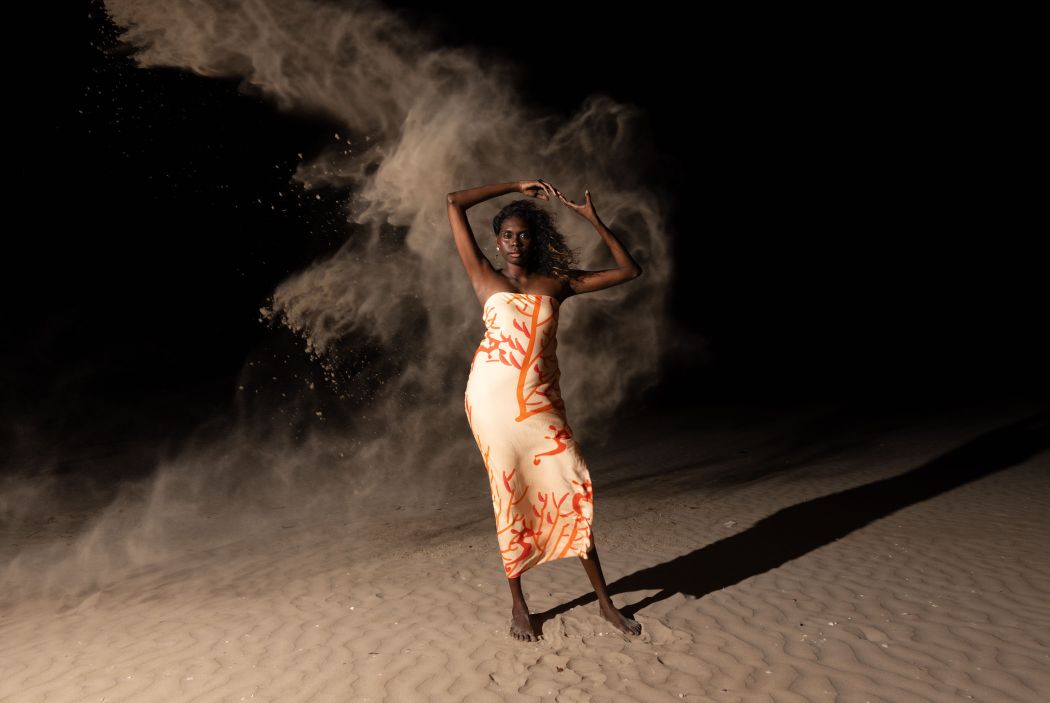
Each collection begins as an artwork, hand-illustrated and digitally refined by Ms Gaykamangu herself, then translated onto fabric. The result is clothing that tells stories - garments designed to move with the body while reflecting connection to place.
"I am not just creating clothes," she said. "I am creating connection between wearer and story, between art and commerce, between traditional and contemporary design."
That philosophy extends through every stage of the business. LIANDRA produces in small, ethical runs and invests in sustainable fabrics. The brand's 40 per cent year-on-year growth reflects the strength of its purpose-driven model, proving that cultural integrity and commercial success can coexist.
From the beginning, Ms Gaykamangu has used her label as a platform for representation and opportunity. In 2024, the company created more than twenty professional placements for First Nations creatives (most of them women) through paid work, mentoring and training. Many of these took place in the Northern Territory, ensuring that success translated into real pathways for others.
One of the earliest examples was a 2023 collaboration in Milingimbi, where Ms Gaykamangu worked with local stylists, models and photographers to deliver workshops in storytelling, styling and production. The project culminated in a four-page editorial in Harper's Bazaar Australia, produced entirely in the Territory by an all-Indigenous creative team led by Yolŋu artists.
From that program her niece, Tarlisa Gaykamangu, was discovered by a leading boutique modelling agency and went on to become the first Indigenous Australian to walk for Bottega Veneta at Milan Fashion Week.
"This is the ripple effect of what happens when we invest in our communities," Ms Gaykamangu said.
That ripple continues through a series of collaborations that balance creativity and strategy. LIANDRA has partnered with Pared Eyewear on a capsule of custom sunglasses, and with Ultraceuticals on a holiday campaign that brought fashion and beauty together through original print design for the skincare company's 2024 Holiday Collection.
Campaigns have featured Jesinta Franklin, an advocate for women and First Nations voices, and Magnolia Maymuru, a Northern Territory model, acclaimed actress and mother whose presence embodies the brand's message of strength and identity.
"She represents the women we design for - strong, connected, and unapologetically grounded in who they are," Ms Gaykamangu said.
These collaborations have helped build national visibility while keeping production anchored in the north. Most campaigns are shot in the Territory, reinforcing the label's commitment to investing locally and working with remote and regional creatives. Partnerships, she emphasised, are never just for visibility, "they are about impact".
One ongoing partnership with Schwarzkopf Professional, through its global Shaping Futures program, delivers professional hair and styling training to young First Nations people.
The initiative was re-launched from Darwin in 2024 and is expanding to Sydney in 2025, creating sustainable career pathways into the fashion and hair industries rather than one-off opportunities.
LIANDRA's national growth has been equally deliberate. The brand became the first Indigenous fashion label in Australia to secure a national wholesale agent, placing collections in stores across the country. This commercial expansion, Ms Gaykamangu said, is built on the same foundations that define her creative practice: purpose, agility and innovation.
Recognition has followed. She was named 2024 Designer of the Year at the Marie Claire awards and has since been invited to join the judging panel for 2025. Her growing influence has led to roles on the Australian Fashion Week Committee, the First Nations Advisory Committee for Mannifera, and the Australian Pacific Economic Cooperation Committee, where she contributes to national and international discussions on trade and innovation.
"Our distance from the centre is our advantage," she told the conference.
"We are grounded by Country, surrounded by language and led by kinship. Our creativity isn't diluted by trends; it's shaped by truth," she said.
That distance, she said, teaches adaptability. When floods delayed production in Bali or tariffs shifted in the US, the business adjusted.
"That's what regional founders do," she said. We don't just survive - we innovate."
Ms Gaykamangu was recently listed among the Northern Territory's Top 20 Young Entrepreneurs and in the Australian Top 250 Young Entrepreneurs 2025, acknowledgements she views as collective recognition.
"They prove that regional and Indigenous excellence belong in every national conversation about innovation and enterprise," she said.
Despite her international reach, Ms Gaykamangu continues to return to East Arnhem Land to shoot campaigns and run workshops.
Her approach remains grounded: people first, then product, then profit. Cultural safety, she said, is embedded in every business process, and collaboration is treated as a long-term investment in shared success.
LIANDRA's story has appeared in Vogue Australia, Vogue, Marie Claire, Elle Italy, Grazia, Women's Wear Daily and other leading titles.
Ms Gaykamangu acknowledged the role of Indigenous media, including National Indigenous Times, in amplifying her work and the stories of other First Nations creatives.
"When you lead with purpose, the right partners and platforms will amplify your story," she said.
For Ms Gaykamangu, that story has now come full circle. After years away studying and teaching, she has returned home to build a business that honours her father's wish to "come home when you're ready". Every collection, every collaboration, she said, is a way of honouring that promise.
"The future of Australian fashion is regional," she told the conference. "It's sustainable, and it's proudly Indigenous."