




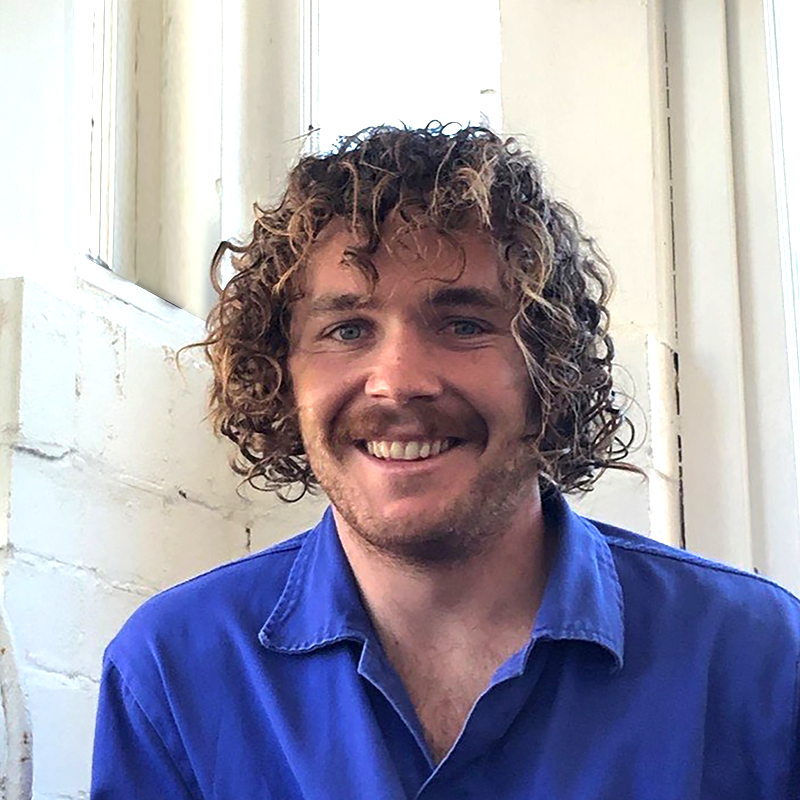

Aretha Brown's contribution to After the Rain - the National Gallery of Australia's fifth Indigenous Triennial - is one of her most significant works to date; as the next step in her burgeoning career and in her commitment to 'Teach Black History'.
"I'm doing this huge 50-metre mural detailing the timeline of this country and the 'birth of this nation', whatever that means," she told National Indigenous Times.
"From the dreamtime to Cook's arrival, first contact, 1930s to revolutionary '60s, Sydney Olympics then to the present day, the referendum, Treaty, and also Blak future."
"It's definitely culturally my biggest work, in terms of what it means to me."
The Gumbaynggir artist, raised on Country in Nambucca Heads, relocated to Sydney from her base in Naarm earlier this year in large part for her exhibition, to throw herself into the "lion's den" of European Arrival.
"I'm depicting arguably the darkest moment in our country's history," she said.
"I kind of felt a little bit like an imposter trying to draw, the Endeavour, or the First Fleet sitting in my studio in Brunswick. I went, 'This doesn't feel real. I'm just looking at other photos, and I'm trying to feel something that doesn't exist right now'.
"This sounds crazy...but I actually went on the Captain Cook. There's a fake Endeavor ship that sits in Darling Harbour. I went on it.
"Hear me out. I had to really feel... imagine 200 years ago, I was sitting here and I saw a ship mast come over the horizon. How would that feel?"
Brown said she needed to physically go to the heart of that history.
"I had to go to these kinds of places and really feel like I was in the lion's den to understand and make a work that felt real. Because it didn't feel authentic, otherwise," she said.
It's the latest mural in Brown's distinctive style and medium.
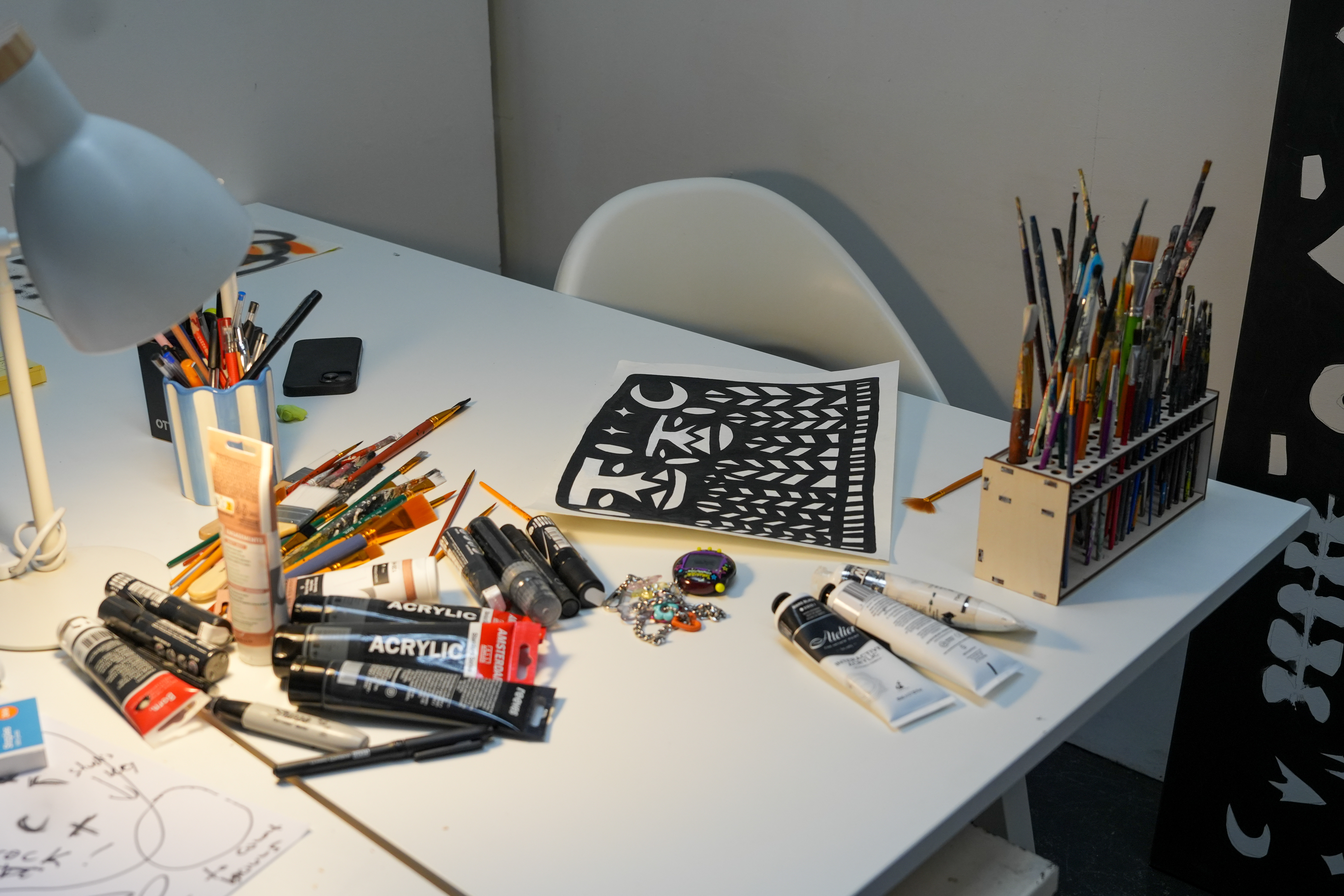
Over 70 public street art pieces into her career, including several overseas, and with her Collective Kiss My Art, it's an active effort "take up space" and "decolonise" the cities and suburbs using her own brand of symbols, or "twist" on those passed down to from the women in her family.
Her often sole use of black and white paint has a humble origin.
"I was just a broke student, and I literally could afford one litre of black paint, one litre of white paint, and that was it," she said.
"I kind of like my style, and I know where that came from. I see the world in black and white as an Aboriginal person. And so my works are black and white. There are no grey areas.
"When I was in art school, people were expecting me to do dot. My mob, we're Gumbaynggir. We're not dot artists or desert people. Even that expectation of dot art in the very beginning, I went, 'No way. I'm doing whatever I want'. And so I drew up my own style with my own symbols my own way."
Brown's mother and grandmother are and were deadly painters, she said.
"My campaign and my motto, I guess, is to teach Black history. It's pretty simple."
"It's about people understanding that this country has a Black history, a Black present and a Black future as well. For me, it's always come down to (saying) Aboriginal culture is so unique. It's so special. It's so beautiful."
She added sometimes it feels as though Australia takes this for granted.
"This country's got a bit of catching up to do in terms of, you know how it thinks about Aboriginal art...there's lots of stereotypes still out there, lots of misconceptions," she said.
"It's all about subverting the stereotype of what Aboriginal art is. It's not all desert art, which, by the way, is beautiful and incredible...but there's more than one way of being an Aboriginal artist, just because there's also more than one way of being an Aboriginal person.
"This is all history...these are symbols the blak women in my family have taught me and passed down to me. And if you cut off Aboriginal people's ability to make art, you've just severed song lines, you've severed thousands of years of art and education and history. It's like burning a textbook."
Brown launched herself into the scene with her first painting selected for a major exhibition at the National Gallery of Victoria in 2018, still in her teens.
It was a swift entry into the national art sphere for the now 25-year-old, first doing art classes in year 12 at school, and one of just two Black students, she said, in her classes at university.
With what she's labelled her first proper exhibition, she's mixing it with a hero and someone she studied, and thanks to an 'iconic' name in Australian art.
Brown is sharing a room with Vincent Namatjira at After the Rain at the NGA from this weekend on, led by artistic director and her "deadly mentor" Tony Albert.
"I can retire after this... he's (Namatjia) truly my hero. He's the most exciting iconic painter I think we've got in this country. To share a space with someone that I studied is like, it's a bit of like, pinch me moment," she said.
"After the Rain is about rebirth and new beginnings. It symbolises planting new seeds and our reasons for doing so. After the Rain carries cultural, economic and political weight, and gives artists a rich and diverse set of themes to explore. When you visit, I want you to be transported, fully immersed into the artists' worlds."
Alongside Brown, featured artists include Alair Pambegan, Blaklash (Troy Casey and Amanda Hayman), Dylan Mooney, Jimmy John Thaiday, Alair Pambegan, Naminapu Maymuru-White, Thea Anamara Perkins, Yarrenyty Arltere Artists and Grace Kemarre Robinya, and Warraba Weatherall, alongside Albert Namatjira, Vincent Namatjira, Hermannsburg Potters, and Iltja Ntjarra Art Centre as House of Namatjira.
The Exhibition opens December 6 on Ngunnawal and Ngambri Country.