






Joining a series of contemporary First Nations artists from across the country, this week Yolŋu artist Naminapu Maymuru-White will showcase her work at the 5th National Indigenous Art Triennial through an exhibition titled 'After The Rain'.
Maymuru-White is one of the most highly regarded artists working at present in Australia. At the age of 72 her works are included in prominent collections and important exhibitions both in Australia and overseas.
Participating artists will present 10 new immersive projects at the exhibition which features 10 large-scale, multi-disciplinary installations celebrating intergenerational legacies and cultural warriors of the past, present and future.
The commission features projects by artists including Alair Pambegan, Aretha Brown, Blaklash, Dylan Mooney, Hermannsburg Potters, Itja Ntjarra (Many Hands) Art Centre, Vincent Namatjira, Jimmy John Thaiday, and Naminapu Maymuru-White.
Built upon existing relationships cultivated over many years, artistic director, leading contemporary artist and Girramay/Yidinji/Kuku-Yalanji man, Tony Albert, worked closely with exhibiting artists, challenging them to produce their best work and inviting them to respond to the exhibition title, which for Albert represents rebirth and new beginnings.
Speaking of her work for After The Rain and collaboration with Albert and the team, Maymuru-White explained what the lead up to the exhibition involved.
"I found it really interesting and helpful, I really appreciated working alongside Tony and the team from the NGA, I enjoyed spending time with Tony in Yirrkala sharing my work and art centre to give him a deeper understanding of my work and community," she told Style Up, a National Indigenous Times publication.
"When we share the patterns and designs passed down from our ancestors it shows us the way to live our life, sharing the journey and our connection to the Milŋiyawuy, the Milky Way. My work is about the cycle of life and our journey here on earth and in the stars.
"I make my art using materials harvested from the land, ochres on ṉuwayak-stringybark, Larrakitj - memorial poles, and found timber boards, I also enjoy printmaking including linocuts, etchings and screenprints."
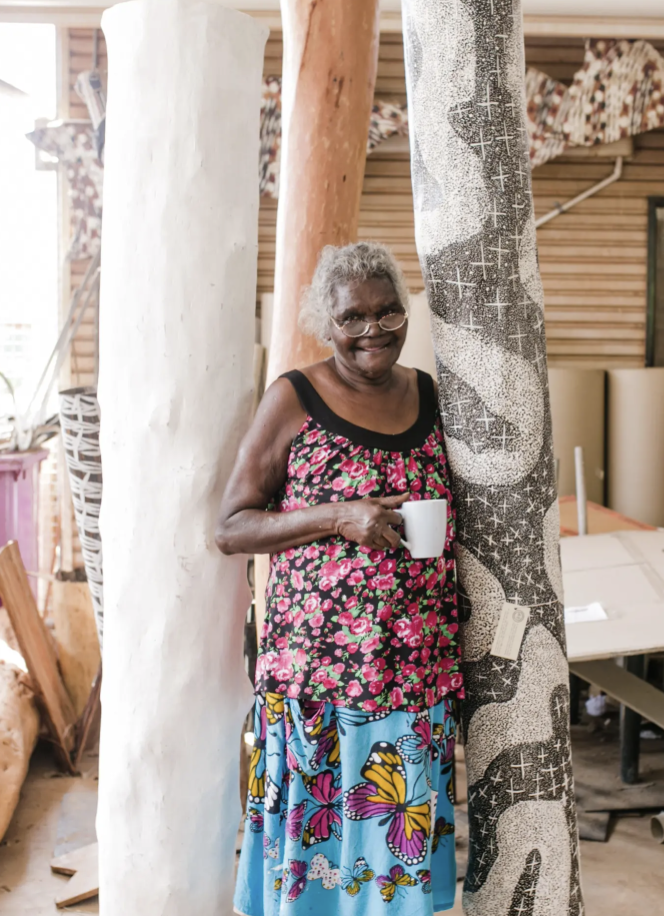
Maymuru-White reflected on the beginnings of her journey as an artist.
"My paintings show the night sky in black and white ochre but sometimes I still paint with other colours including red and yellow ochres," she said.
"When I first started painting the river known as Milŋiya I used a sharpened length of wood to apply the patterns and dots of the stars in the milky way as they are reflected in the water, I watched and learnt from my father who used this technique to apply fine dots that represent the stars and bubbles in his paintings that depict our Maŋgalili clan designs and stories.
"Now I use lengths of wire in different diameters help me to create these patterns with more ease and less sharpening."
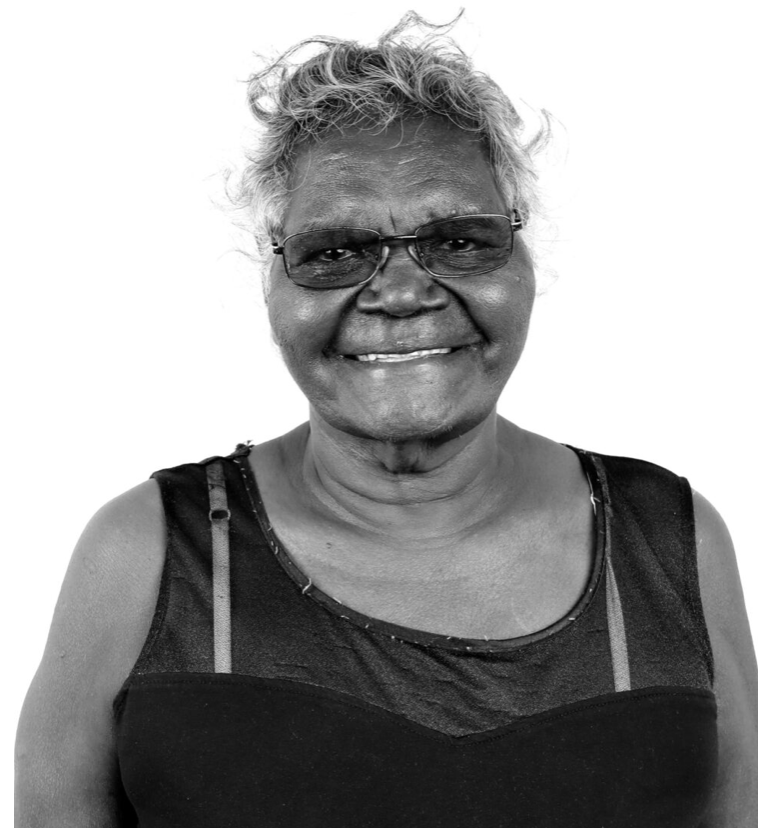
Maymuru-White said her homeland heavily influences all her work, including her work for After The Rain.
"My homeland is Djarrakpi at the base of Cape Shield in the northern part of Blue Mud Bay, it's a special place for me and my family, it's where our spirit is born and will return to when we are gone," she said.
"My paintings are from there, they share the stories of the land, sea and the river on earth and in the sky.
"In a Yolŋu world we know that everything is connected, people, land, sea, animals and the sky. When I look up at the night sky I can see my ancestors but I can also feel connected to friends and family that are a long way away.
"I hope my work helps everyone to feel more connected when they look up at the night sky."
Maymuru-White said her spirit keeps her strong when times are tough.
"Even if I'm feeling weak my spirit is still there, when I was young my father wanted us kids to be together learning our stories and how to paint and continue his work to represent our Maŋgalili (clan) family, I'm worried that we are losing our leaders and now I see myself as a leader - it's my responsibility to keep this story strong and lead my family/community," she said.
"I share the story of the river and the stars and we work together even my grandchildren will know the stories passed down from our ancestors."
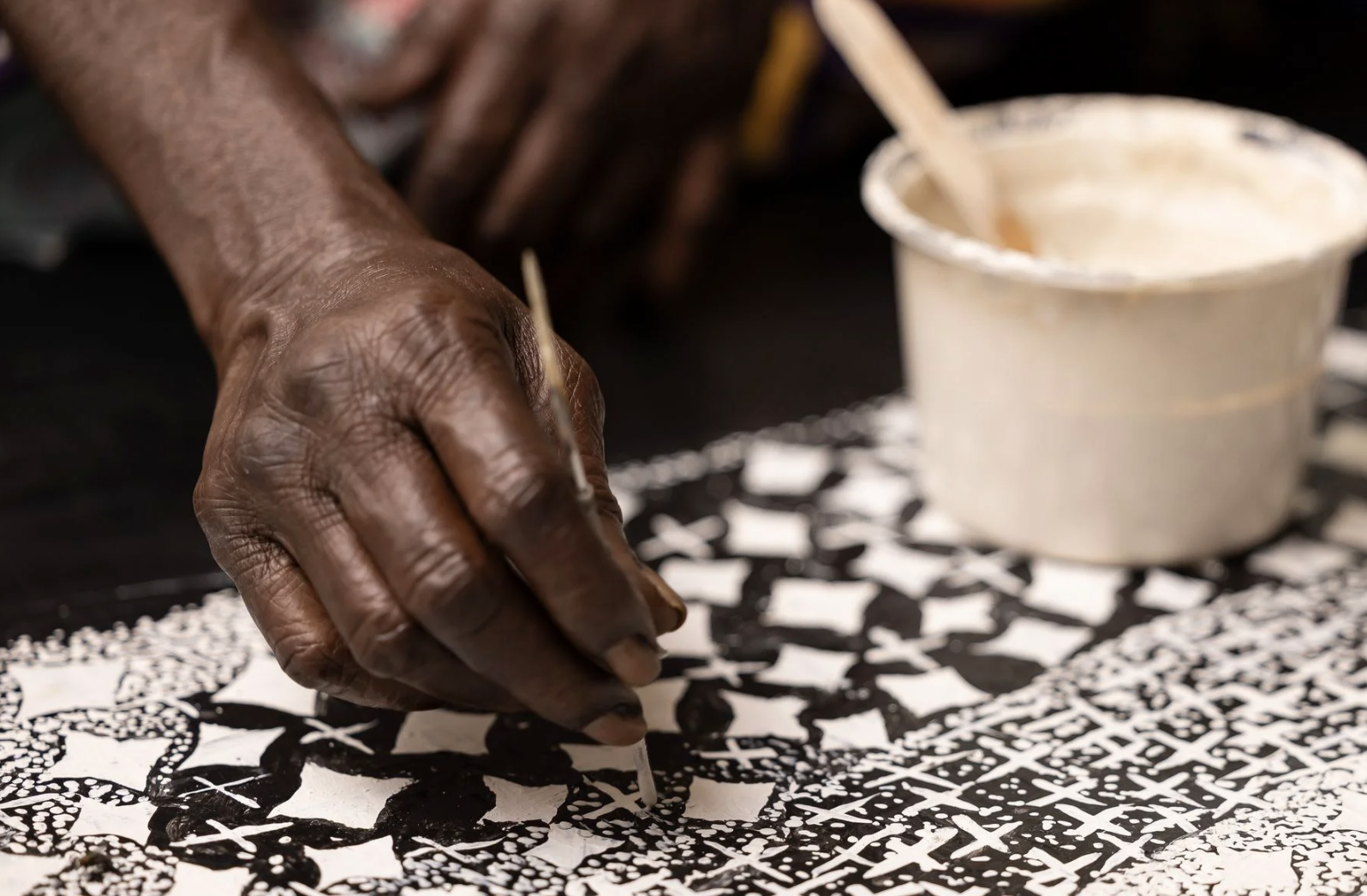
With this year's exhibition highlighting rebirth, Maymuru-White spoke on what the idea means to her at a personal level.
"When I think of rebirth it is about a cycle of life, our Gurrutu kinship system connects us all to each other and to all things and our ceremonies and songs connect us with the spirits of our ancestors and our country," she said.
"When I leave this place on earth, I will become part of the Milniyawuy - Milky way and my children and their children can see me up there as one of the stars.
"My art is real, it is the truth for us and will never stop or change, our law and knowledge is there and has been passed down through my family and clan for generations.
"Every line carries a memory of the land, our ancestors and the laws that guide us. When I paint I'm not just creating something new and beautiful for you to look at, I'm continuing my duty to keep our culture strong and teach my family and the world of our law and our land, our culture is alive now it's not just stories from the past."
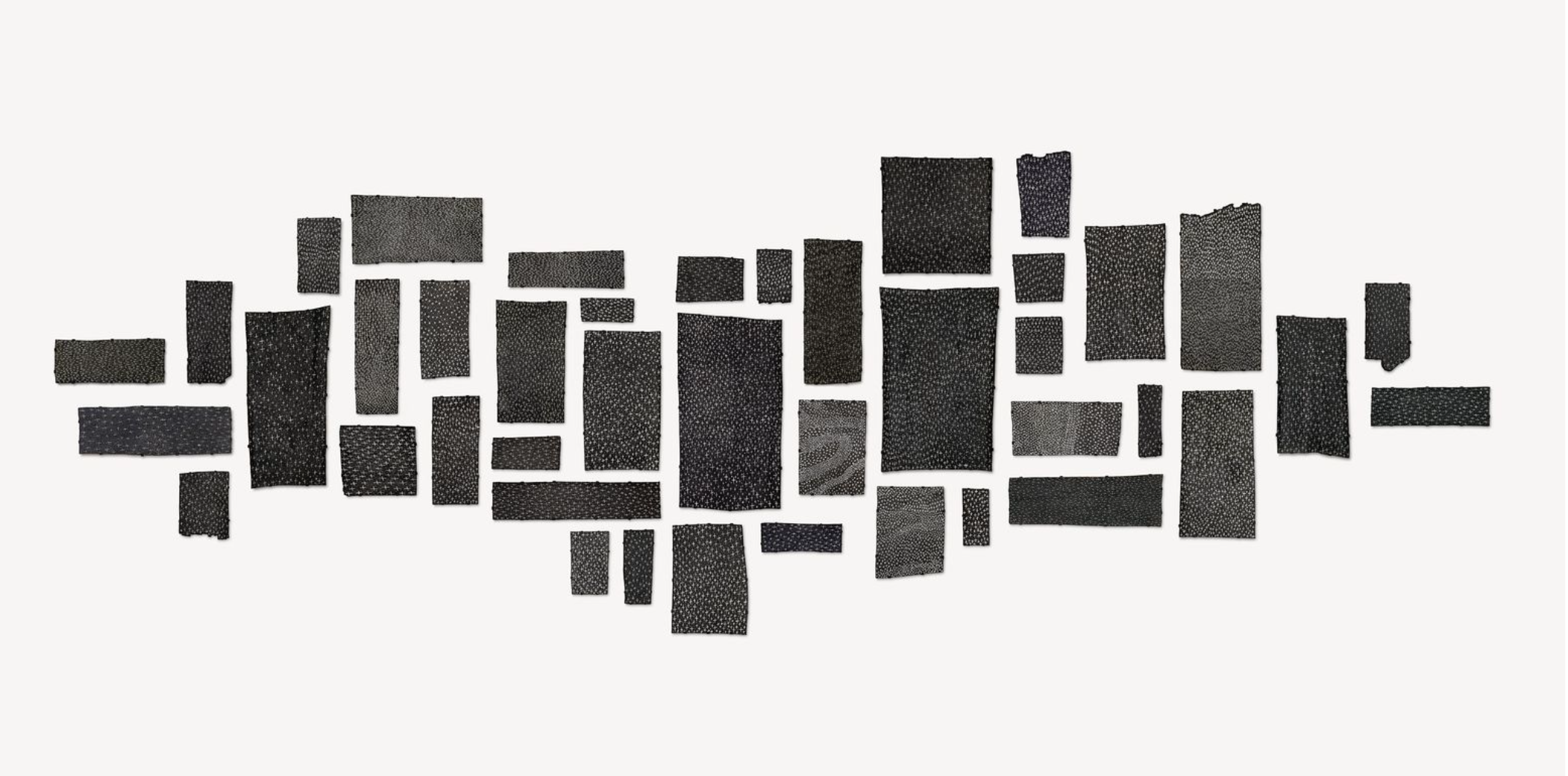
Maymuru-White said she is thrilled her work will be touring nationally.
"I'm really proud of my work and sharing it with others, I want to take them to Djarrakpi to see the reality of the milky way and the way it forms, how we see the different shapes that we can really see in the night, this is the truth of the milky way," she said.
"It's like a performance of the stars forming into animals. We can see these shapes in the darker area's of the Milky Way.
"Our art will never ever change, it continues, it is really important to Yolŋu people, we got to show ourselves stick to that law. The designs will never change but our tools and methods can, it can change from bark to metal from print to computer, recently I saw my grandson making the milky way painting on the computer.
"This story is based on the land and it's got to be told over and over for the new generation so they know our story.
"I will continue to teach my family so when I go they know everything, I will never give up, maybe my ageing will stop me but my mind and my spirit will always be strong and never give up."
The 5th National Indigenous Art Triennial: After the Rain is made possible with the support of the National Gallery's First Nations Arts Partner, Wesfarmers Arts, and key philanthropic supporters.
Entry is free to After the Rain, which will be on display at the National Gallery in Kamberri/Canberra from 6 December 2025 - 26 April 2026.
Following its exhibition at the National Gallery, After the Rain will tour nationally from 2026 - 2028.
For more fashion, arts, culture and lifestyle news subscribe for free to the Style Up newsletter.