





On Kalkatungu Country in north-west Queensland in 1884, Aboriginal men and women were killed during a violent confrontation with colonial forces at a place now known as Battle Mountain.
In official records, the incident was long described as a skirmish — an episode of frontier conflict in remote land.
However in Kalkatungu memory, it was a massacre.
For much of Australia's history, those two versions rarely touched.
One lived in police files and parliamentary papers.
The other was carried through families, through story, through Country.
Nowdays, Indigenous art is bringing them back into the same frame.
In Battle Mountain Memorial, a large-scale work by Kalkatungu artist Ricky Emmerton, the event is not treated as a closed chapter of colonial history.
It is rendered as something unresolved and ongoing.
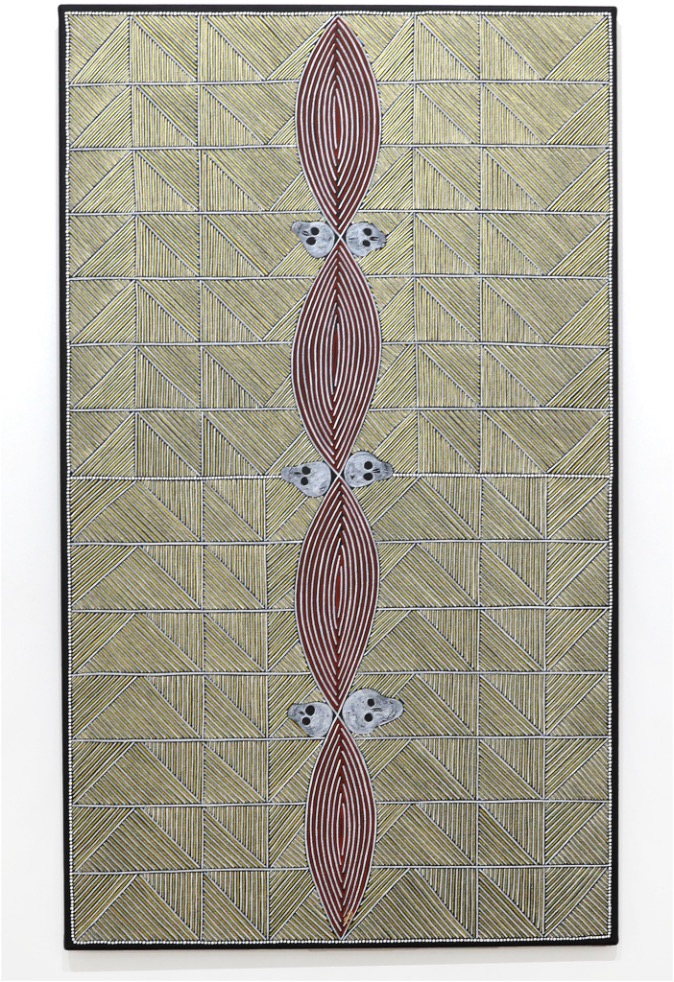
Figures appear and fade across the canvas. There is no central scene, no clear victor, no sense of completion. What remains is loss, memory and insistence.
The painting sits at the centre of new academic research examining how Indigenous art functions as a form of truth-telling — not as illustration or metaphor, but as a record in its own right.
Co-authored by Mr Emmerton and scholars at James Cook University, the research argues Indigenous visual art has long carried histories that were minimised or left out altogether of mainstream accounts.
Rather than responding to history, the paper suggests, works like Battle Mountain Memorial are doing historical work
For Mr Emmerton, the painting is not about revisiting the past so much as continuing it.
The story of Battle Mountain was never lost, he argues. It was simply never written down in places that later came to be treated as authoritative.
"Art holds what paper didn't," he has said.
"It carries what was passed on when there was nowhere else to put it."
The research traces how colonial documents framed the 1884 killings through the language of frontier conflict, masking the scale of the violence and its impact on Kalkatungu people.
Battle Mountain is not an isolated case.
Across the country, Indigenous artists are increasingly recognised as custodians of historical knowledge, particularly around massacres and frontier violence that remain unevenly recorded in official histories.
What sets Battle Mountain Memorial apart is its refusal to offer closure.
The work does not try to settle the past or make it easier to absorb.
Instead, it insists that the consequences of frontier violence are not confined to the 19th century, but continue to shape the present.
The researchers describe this approach as decolonial truth-telling: a form of historical practice which does not rely on institutional approval and actively questions the authority of colonial archives.
In this framing, Indigenous art is not filling gaps in the record so much as asking who decided, in the first place, what counted as a record.
In that space, art has taken on a particular weight.
The paper argues that works like Battle Mountain Memorial do more than commemorate.
For Emmerton, that unease is deliberate.
"The past doesn't sit still," he has said. "It moves with us."