





Expansive in scale and its traversing across the continent, traditions and time, '65,000 Years: A Short History of Australian Art' takes caveat away from how generations upon generations of tradition was once left on the periphery.
Featuring more than 400 works, 65,000 Years opened with the return of the University of Melbourne's Ian Potter Museum, Wurundjeri Country on Friday.
"It's not Aboriginal art. It's art," co-curator Judith Ryan told National Indigenous Times.
In addition to holdings in the university's collection, 193 loans from 77 public and private lenders make up the mutli-story, multi-disciplinary exhibition at the gallery.
Many of the works, including cultural objects, have rarely been seen.
The title, purposely ironic, speaks to the long time "belated and reluctant" recognition of Indigenous art left waiting until the late 20th century, fellow co-curators Shanysa McConville and Marcia Langton said.
"I think this exhibition will change the way people think about Indigenous art," Professor Langton told National Indigenous Times.
"I think it will change the attitude of curators and gallerists, art history departments, art critics, artists and students, because it is so very recent in Australian history that Aboriginal and Torres Strait Islander art traditions have been recognised as art and included in the canon of fine art."
Professor Langton said examples of recognition were periodically present from British arrival, at times through the 19th and 20th centuries, but largely silenced in formal institutions.
"Then we see this dawning recognition and acceptance of Aboriginal art in main galleries. Not downstairs in the primitive gallery, in the main galleries," she said.
"And what young people inherit today is a vastly changed world, even from the 1980s."
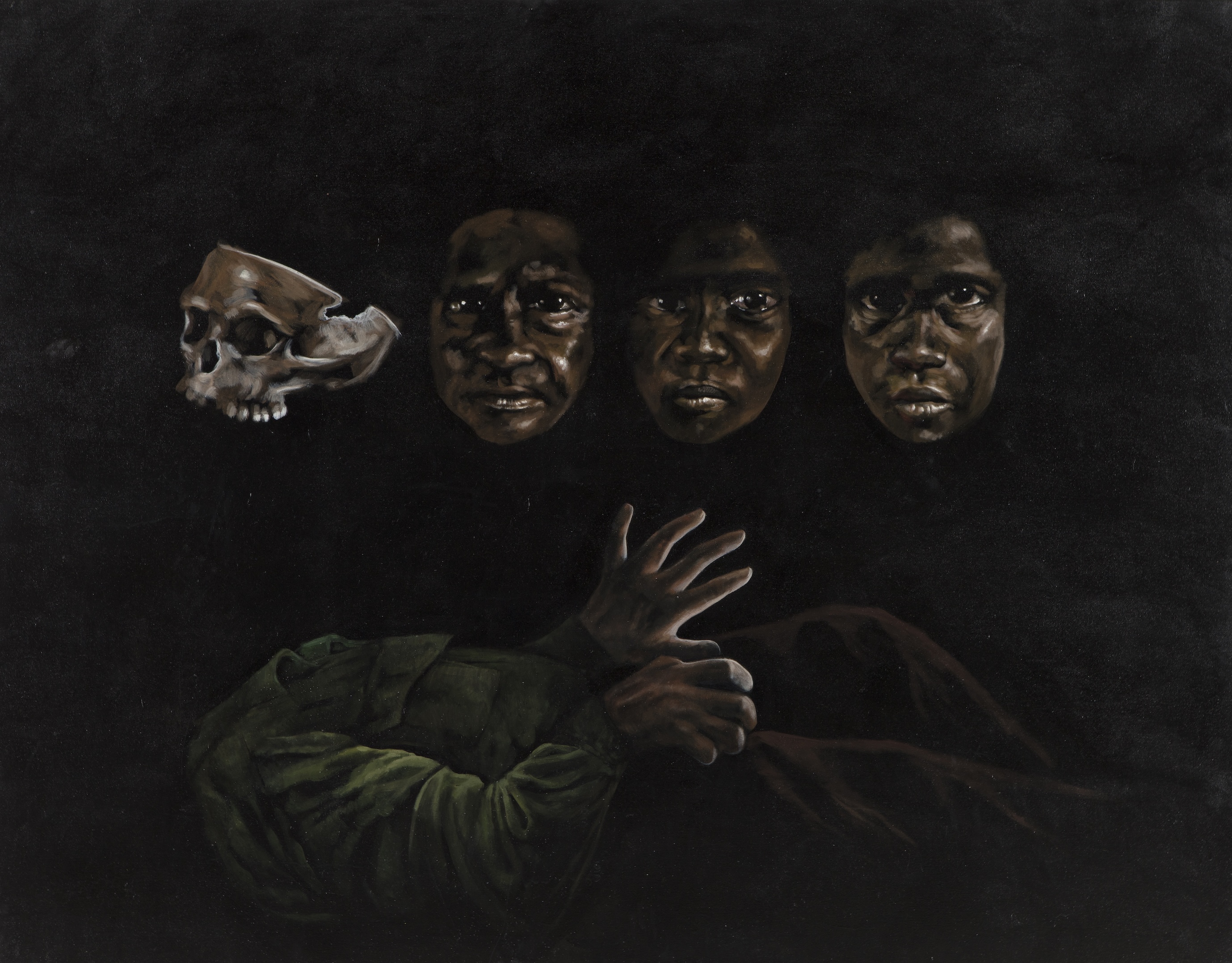
More than 200 individual artists are featured in the collection, including Emily Kam Kngwarray, Albert Namatjira, Judy Watson, Julie Dowling, Paddy Bedford, Rusty Peters, Gail Mabo and William Barak.
Upon entering the ground floor, Kooma artist Brett Leavy's 'Virtual Narrm 1834, 2025' depicts Wurundjeri lands and waterways as they were two centuries ago in this latest virtual songlines project.
Trawlwoolway artists Julie Gough and Vicki West (with separate works), Waradgerie artist Lorraine Connelly-Northey, Dhauwurd Wurrung Gunditjmara artist Sandra Aitken, Aṉangu artists Betty Muffler and Maringka Burton were commissioned alongside Leavy.
"It's the most significant exhibition I've ever curated," Ms Ryan said, who spent 44 years with the National Gallery of Victoria, where she served Senior Curator of Indigenous Art.
"The contextualisation of Aboriginal and Torres Strait Islander art in relation to its history, its difficult history, the scope of the range of the works the different art movements that have sprung up across this continent...We trace these moments."
The exhibition places confronting chapters of Australia's post-colonial history on display: works from early European arrival to the University of Melbourne's historic eugenics practices.
"Many works are works of truth-telling. They're not simply decorative," Professor Langton said.
"They are not only profoundly symbolic of Indigenous knowledge systems and cosmological systems. They also tell history. And you can see that throughout the exhibition.
"It occurred to me that I could not ignore this period of racial scientism and eugenics, because so many Aboriginal artists had addressed it."
Co-curator Shanysa McConville headed associated archival documents with this portion of the exhibition.
Community consultations, confirmations around potential restrictions to exhibit and deep conversations "to make sure we got this narrative right" was an intensive aspect of the four-year curatorial process, she said.
In a portion displaying works from the Australian Wars, portraits by non-Indigenous artists are accompanied by Indigenous artists Ms McConville said, important in presenting a "dialogue…responding back to atrocities committed against them and their communities and their kin and the intergenerational impacts of those".
Portraits of ancestors are identified "so communities can come in and actually see these individuals who they have connections with; their ancestors," Ms McConville said.
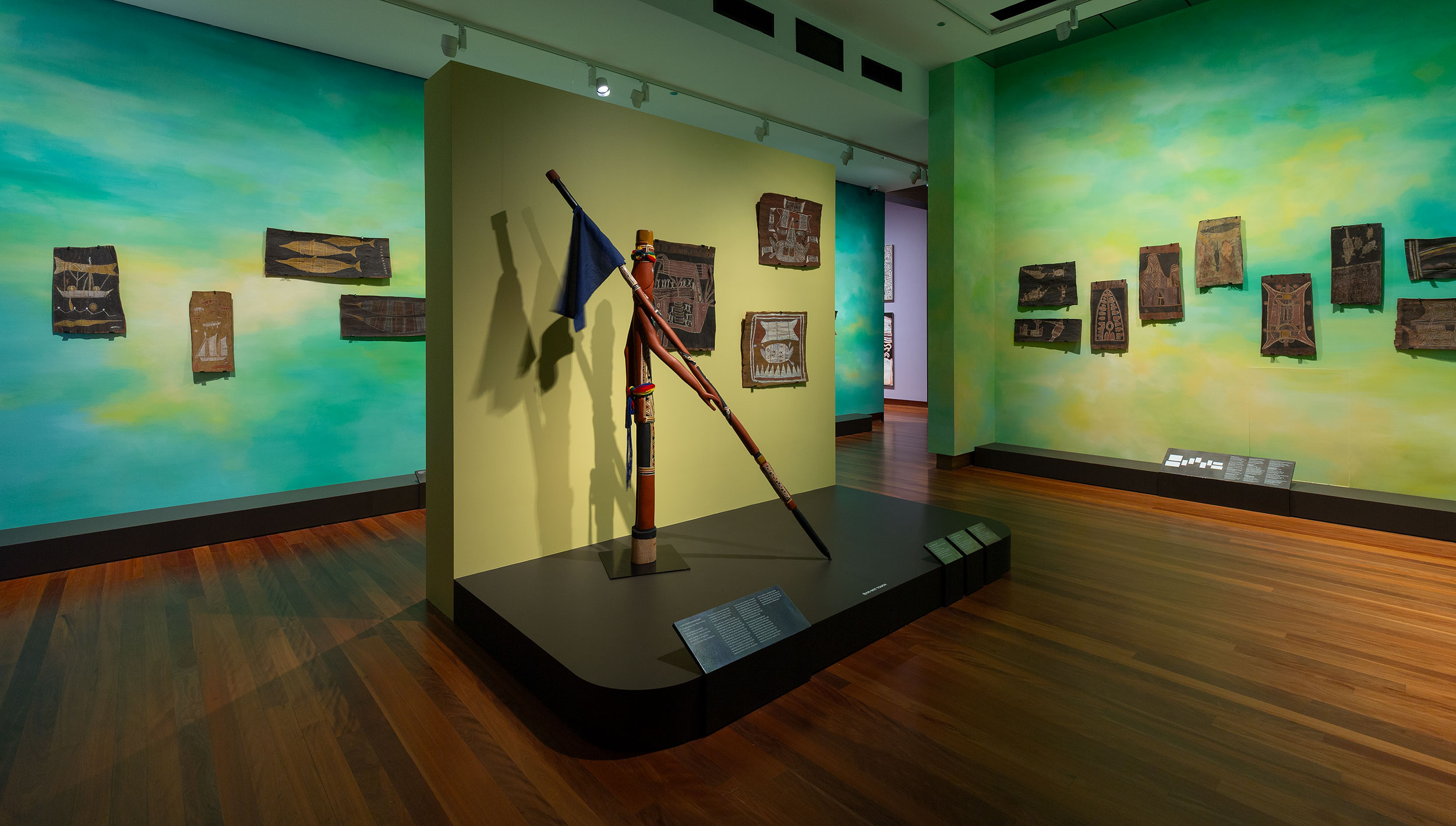
On other floors, pieces celebrate culture and practice and place, such as those featuring the works of Yolŋu and Groote Eylandt (Ayangkidarrba) artists, discard blank white or black walls convention for colour reflecting their Country's landscape.
Professor Langton described this as a rejection of "uniform abstractionism".
"This art is full of meaning, full of history, full of stories," she said.
"They're not empty abstractions. They are profoundly symbolic works. They're conceptual works that depict cosmologies, cultures, sacred narratives. And so we wanted to capture that profundity in the way that we curated it, with the colors and with the groupings.
"The works are not exhibited randomly. They're exhibited in their historical and cultural context. It's not didactic and chronological, but you get the sense of the period, the culture, the very local culture, the very local history as you walk through the exhibition."
Professor Langton says 65,000 Years: 65,000 Years: A Short History of Australian Art is a "blockbuster".
Ms McConville feels it's an expression of defying expectations and stereotypes.
"(It defies) thinking about what Aboriginal and Torres Strait Islander art can be," she said.
"It isn't just working with ochre. It isn't working with specific mediums. It isn't using particular iconography. It can be anything and everything."