




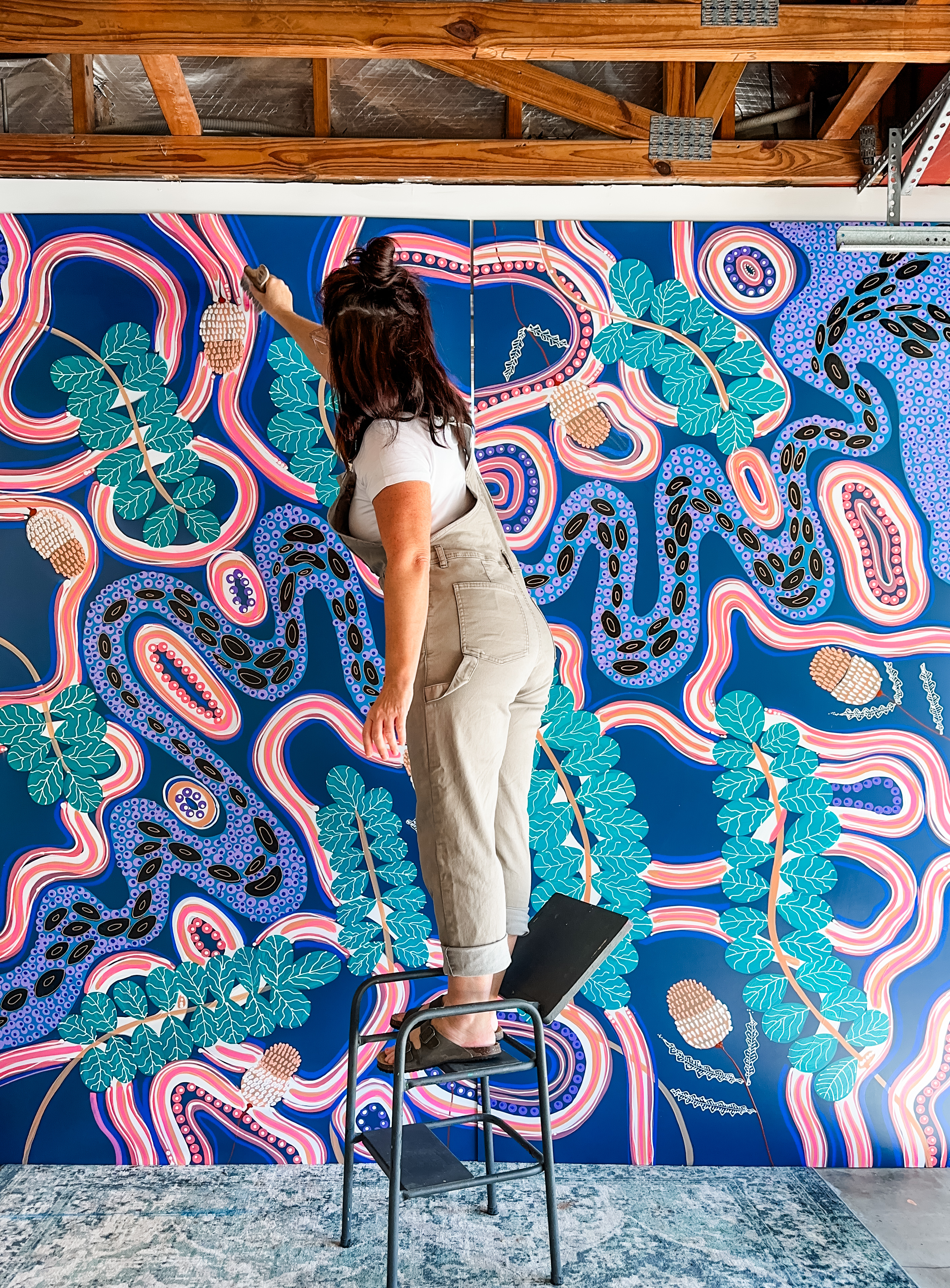
Chern'ee Sutton is one of a growing number of Indigenous artists whose work is being copied and sold using AI, which experts warn is worsening Australia's huge problem with counterfeiting of Aboriginal art.
Australian Indigenous-style souvenirs sell for $250 million annually, but more than 60 per cent are fake, found a 2022 investigation by Australia's Productivity Commission.
The 2022 report found Indigenous artists earn just $1,800 a year, on average. A key reason for the low level of this income was due to the market being flooded by fake Aboriginal paintings made overseas, imported to Australia, and then mostly sold to tourists by non-Aboriginal businesses.
Now the future of Aboriginal artists is facing an even greater challenge due to AI technology which can copy or mimic any type of Aboriginal design, as Ms Sutton has discovered. A Kalkadoon woman from the Mount Isa area of North-West Queensland, she and her sister Brooke are considering legal options after recently discovering AI versions of Brooke's art being sold online by an Australian website.
"People need to realise that just because they're buying a piece of art or a product that has Indigenous art on it, does not mean that it is art created by an Indigenous Artist," Ms Sutton told National Indigenous Times.
"The best way to ensure that you know exactly where the art is coming from is to ask who the artist is and if there's no artist mentioned there's generally a reason."
The counterfeiting of Aboriginal art is now "on steroids" due to the impact of AI, said Dr Louise Buckingham, CEO of the Arts Law Centre of Australia, the country's only community legal centre supporting artists.
Dr Buckingham said the centre offers free services for Aboriginal and Torres Strait Islander artists, who frequently report concerns about counterfeiting.
"I'm not aware of any more recent study conducted along the same lines (as the 2022 investigation into counterfeiting) but all evidence points to it being way, way worse now, thanks to generative-AI running roughshod over culture and law," she said.
Dr Buckingham said the federal government needed to make AI companies, and businesses selling fake Indigenous art, legally responsible for any role they may play in facilitating fraud against Indigenous artists.
"(They must be made) accountable for their theft and authorisation of mass copyright and moral rights infringement, as well as existing encroachments on ICIP and First Nations culture," she said.
"We know it's happening at an inconceivable scale. We need regulation and the law to step up. Anything less is a denial of sovereignty and a denial of these (art) works being a means of self-determination and economic gain for community. It's shameful."
A spokesperson for the Department of Infrastructure, Transport, Regional Development, Communications, Sport and the Arts told National Indigenous Times the federal government does not have data on how commonly AI is being used to copy Indigenous Australian art, but it recognises concerns about the impact of AI on creators.
The spokesperson noted the federal government pledged, in 2023, $13.4 million over four years to help develop new legislation to protect Indigenous traditional knowledge and cultural expressions.
"The Government is progressing measures to strengthen protections for First Nations Traditional Knowledge and Traditional Cultural Expressions, including action to address fake Aboriginal and Torres Strait Islander art, merchandise and souvenirs," the spokesperson said.
"An Aboriginal and Torres Strait Islander Expert Working Group is helping ensure First Nations knowledge, expertise and lived experience inform this work."
For now, however, there is limited legal protection for Aboriginal artists like Emrhan Tjapanangka Sultan. A Western Arrarnta, Luritja and Kokatha man, raised in Mparntwe / Alice Springs, he is the is co-founder of Solid Lines, an independent creative agency which represents Indigenous artists. Mr Sultan said he knows several Aboriginal artists whose work had been used without permission.
He had also noticed many fraudulent artworks for sale that appeared to be mimicking the style of a particular region. Especially the dot art of Australia's Western and Central Deserts, which was commonly manipulated on AI platforms.
"AI adds another layer of worry, making it even more difficult for Aboriginal artists with a deep cultural connection to their storytelling that impacts their way of making a living or a small wage," Mr Sultan told this publication.
"Personally, AI hasn't changed they way that I create art as my designs are traditionally rooted my strong culture and connection to country. Although it has made me extra cautious that AI can steal and manipulate what is Aboriginal art very easily and that people who are prompting AI to create Aboriginal art, it should be made aware that it isn't right or fair to the artists."
Ngarabul and Torres Strait Islander artist Lauren Rogers has been outspoken about how counterfeiting of Indigenous works robs artists and devalues Aboriginal culture. These worries are now deepening due to the use of AI to replicate Indigenous artistic languages.
"What concerns me most is how quickly AI can create something that looks like Indigenous art without any of the cultural knowledge, relationships or lived experience that sits behind the work of an Indigenous artist," Ms Rogers told National Indigenous Times.
"Because our art is not simply a style or pattern. It can carry Country, culture, story, identity and knowledge. When those elements are scraped, reproduced or imitated without consent, attribution or cultural understanding, there is a real risk of cultural appropriation being accelerated by technology."
Consumers can help address this problem, she said, by buying Aboriginal artworks directly from reputable businesses.
"You are not simply purchasing an image or object," Ms Rogers said. "You are supporting an artist, their practice, their family and the continuation of living culture."