






In a time of mis- and disinformation around truth-telling and attacks on Aboriginal sovereignty, rights and history, one priest in Victoria is combining the history of First Peoples through a Christian lens.
Last week, Archbishop Ric Thorpe unveiled five works by Wiradjuri artist and Anglican priest Reverend Canon Glenn Loughrey, drawing on an Aboriginal understanding of Country.
Looking at the Christian journey from Lent to Easter, the pieces explore truth-telling, repair and a renewed relationship between people, Country and the Church.
"It goes through the story of from Lent through to Easter Day, and the process of being on Country, of having some harmony with Country," Mr Loughrey tells National Indigenous Times.
"Having that harmony with Country fractured — which is Good Friday for Christians — for us that's the arrival of the people from somewhere else who came to dispossess us. Then we have Easter Saturday, which is when Jesus is in the tomb, and in some ways that's where we are today."
He argues that up until Good Friday, "we are in sync". But whilst Christians have "moved out of the tomb," Mr Loughrey argues: First Peoples are "still in the tomb".
"Christians have got justice and resurrection," he says. "We are still waiting for that as a nation, as a people."
Asked about that intersection, he notes: "It's not an easy thing to come to terms with."
"Since the [2023 Voice] referendum and a whole range of other issues that have affected my life, I'm finding myself moving back into that tomb space, waiting for the promises I know in the Christian story to actually become true in my own life story and the life of my people," Mr Loughrey says.
"I'm trying to find a way to connect the two stories, and that's part of what this art does — it connects those stories, but allows each one to be separate, and not one to supersede the other, and one to ask questions.
"For example, a Christian story. How do you shift what you've got and place it, and allow us to share that as a people without us necessarily having to become Christian?"
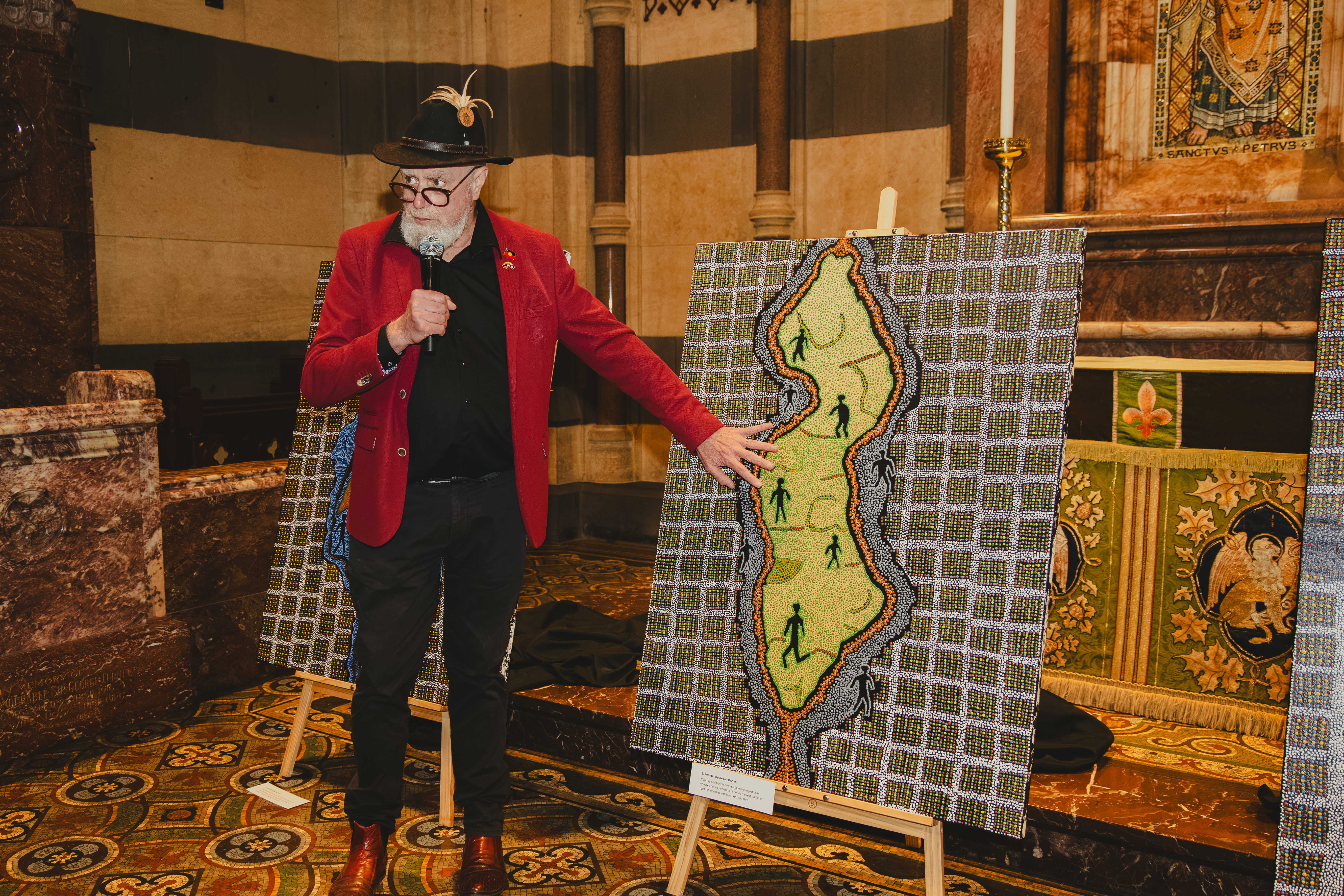
Painting with a meat skewer, he says the construction of the art is both a cathartic and therapeutic process.
"Not so much the topic," he adds, "but the practice."
"It's also very empowering, and it shifts you away from the place of being angry and wanting to tell people off for being terrible to Aboriginal people, to actually saying, 'Here's that story, and here's a way in for you, and it's a way out for me'."
Following its unveiling at St Paul's Cathedral last week, the collection will tour the Anglican Province of Victoria before a painting is gifted to each of its five dioceses: Melbourne, Bendigo, Ballarat, Gippsland and Wangaratta.
Each diocese will hold one part of the story, with the full narrative emerging when the paintings are brought together.
The Church says the initiative embodies Archbishop Thorpe's vision of an inclusive Anglican Church that welcomes people from all cultures and backgrounds and values the contributions each person brings.
"Our calling to reconciliation with First Nations peoples continues through relationship, listening, learning and practical commitment," Archbishop Thorpe said.
Asked what he wants people to take from the pieces, Mr Loughrey says it will be good if it exposes the gap between the "Christian story and the Aboriginal experience".
"And I'm hoping at some level," he adds, "it'll help people to process their own journey without necessarily just doing what they've always done and not thinking through the implications of the Christian story or the implications of the Aboriginal story".