





Crossing three deserts and more than 1,800 kilometres from WA's Kimberley region to the Mid West, the Canning Stock Route is among the world's most remote and unforgiving tracks.
But for proud Juwaliny woman and Bidyadanga artist Bibianna Tumbler, it's a landscape she knows through story, not sight.
Her multi-toned painting My Grandfather's Country maps the Canning Stock Route, marking waterholes and the tracks her family once walked.
The intricate mapping of the terrain is even more remarkable considering Ms Tumbler has never been to the Canning Stock Route.
"My grandfather would tell me stories, where they had been in the desert, walking from one waterhole to the other," Ms Tumbler says.
She points to an auburn-red circle on her canvas.
"This third waterhole is where my dad was born," she says.
Bibianna Tumbler's grandfather and family were forced to walk out of the Great Sandy Desert and relocate to the Kimberley town of Bidyadanga -180 kilometres south of Broome - in the 1960s, amid drought and mounting pressures from authorities and missions that pushed many desert families off their traditional Country.
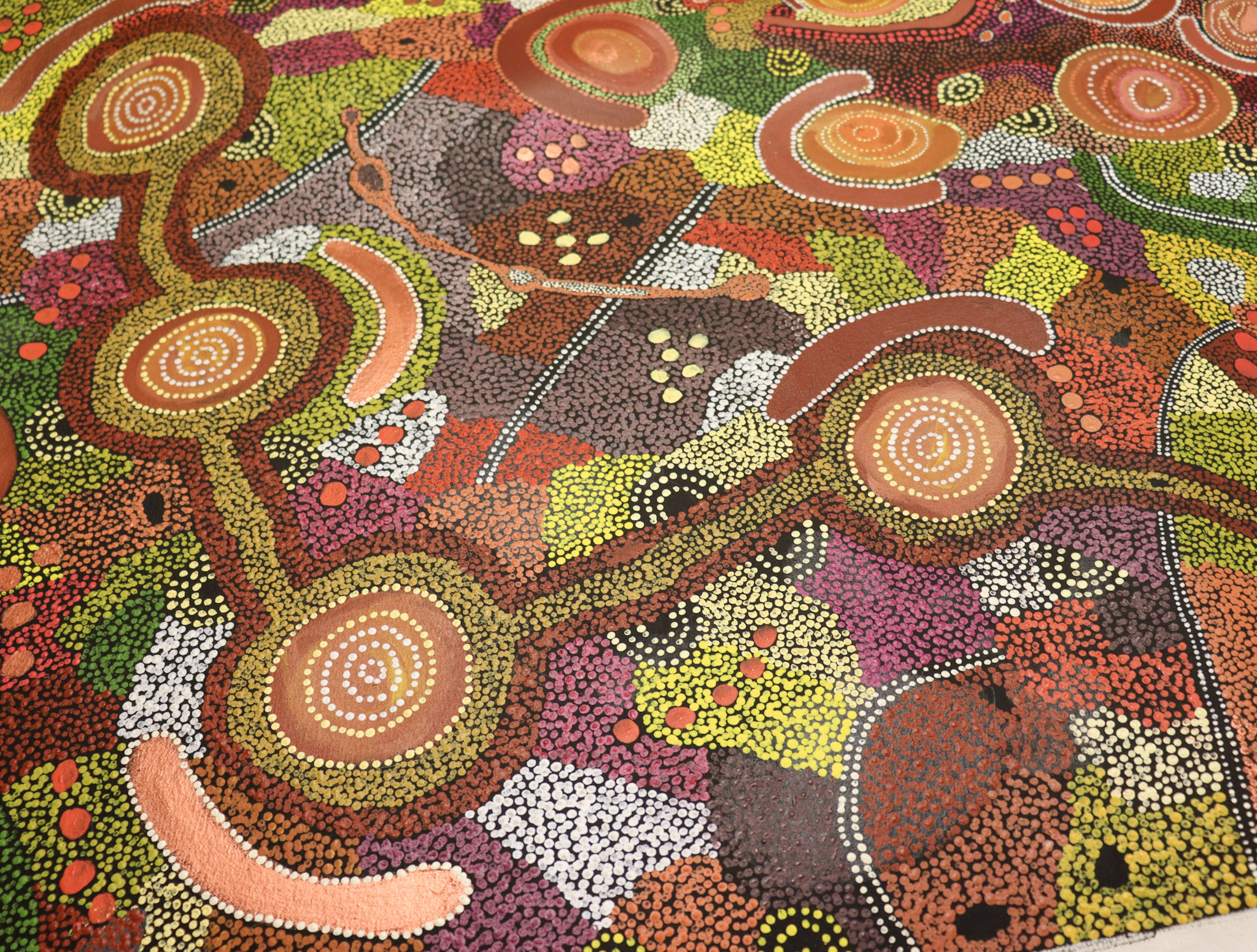
"I see the country in my mind, my mum, dad and grandfather taught me, and then I can paint it," she says.
Turquoise, cyan and capri frame waterholes in another of Ms Tumbler's works, with shades she says reflect the desert's unexpected colours.
"In the Great Sandy Desert we have mudflats that create these colours of blue," she says.
Her works have garnered multiple recognitions this year, with Ms Tumbler taking home the Indigenous Art Award at the Shinju Matsuri Civic Centre exhibition in Broome, and the Aboriginal category prize at the 2025 Kimberley Art and Photography Awards in Derby.
They will also be on display and for sale at this year's Bidyadanga Artists Sale in Broome, from 7-9 November at Redbill Studio and Gallery.
Ms Tumbler will be joined by several fellow Bidyadanga artists, and says she can't wait to share her work.
The annual Bidyadanga Artists Sale brings together painters from five language groups - Juwaliny, Mangala, Yulparija, Nyangumarta and Karajarri - whose families walked out of the desert and moved to the coast.
The exhibition is known for its vivid desert palettes and stories of Country carried across generations.